
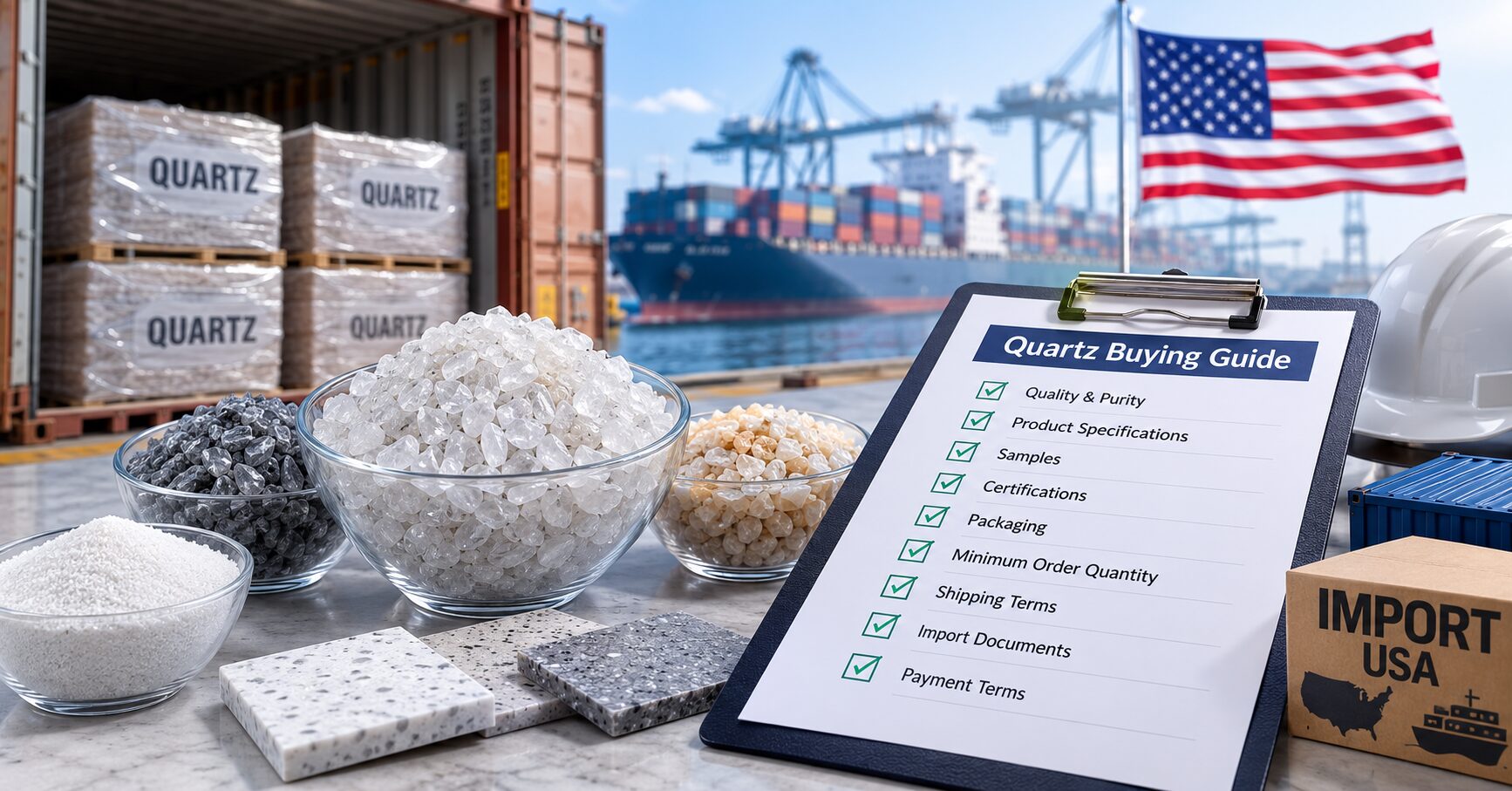
Importing quartz products into the United States can be a profitable decision for distributors, wholesalers, contractors, and manufacturers. Quartz is widely used in countertops, flooring, wall cladding, landscaping, engineered stone, and industrial applications. However, choosing the right supplier involves much more than comparing prices.
A low-cost shipment can become expensive if the material fails quality checks, arrives damaged, or does not meet US market standards. Asking the right questions before placing your order helps you avoid delays, reduce risks, and build long-term relationships with reliable suppliers.
This quartz buying guide explains the most important questions every US buyer should ask before importing quartz products.
Understand Your Quartz Requirements First
Before contacting suppliers, define exactly what you need. Quartz products come in different forms, including:
- Quartz slabs
- Quartz tiles
- Quartz powder
- Quartz sand
- Quartz chips
- Decorative quartz aggregates
- Engineered quartz materials
Each product serves a different purpose. For example, decorative quartz chips are commonly used for landscaping and resin flooring, while quartz powder is often used in glass manufacturing and ceramics.
Knowing your application helps suppliers recommend the right product specifications.
What Is the Purity Level?
Purity is one of the most important factors when importing quartz.
If you’re buying quartz for industrial applications, the silica (SiO₂) content directly affects product performance. High-purity quartz is required for industries such as:
- Glass manufacturing
- Electronics
- Ceramics
- Solar applications
- Chemical processing
Ask your supplier:
- What is the silica content?
- Can you provide a recent laboratory test report?
- Are impurities such as iron, aluminum, or calcium within acceptable limits?
Reliable suppliers should have certified test reports that verify the chemical composition of every production batch.
Are the Product Specifications Consistent?
Consistency is essential, especially for large projects.
Even small differences in color, particle size, or finish can affect the final result. Whether you are importing quartz chips or slabs, request detailed product specifications.
Ask questions such as:
- What are the available sizes?
- Is the color consistent between batches?
- What is the moisture content?
- What are the available finishes?
- What tolerances do you maintain?
Professional suppliers maintain strict quality control to ensure every shipment matches previous orders.
Can You Provide Samples Before Production?
Never place a large order without reviewing samples.
Samples allow you to evaluate:
- Color
- Texture
- Surface finish
- Particle size
- Overall quality
If possible, request multiple samples from different production batches. This gives you a better understanding of product consistency.
Many experienced importers also compare samples from several suppliers before making a final decision.
Which Quality Certifications Do You Have?
Quality certifications demonstrate that a supplier follows recognized manufacturing standards.
Depending on the product, ask whether the supplier has certifications such as:
- ISO quality management certification
- Material testing reports
- Third-party inspection reports
- Product compliance documentation
US buyers often require documentation before approving imported materials for commercial projects.
Working with certified manufacturers reduces quality-related risks.
How Do You Handle Quality Control?
Every supplier should have a documented quality control process.
Ask questions like:
- Do you inspect raw materials?
- How many inspections occur during production?
- Is every shipment inspected before loading?
- Can third-party inspections be arranged?
The best suppliers perform quality checks throughout manufacturing rather than only at the end.
Some buyers also hire independent inspection companies to verify the shipment before it leaves the factory.
What Packaging Methods Do You Use?
Quartz is a heavy material that can be damaged during transportation if packaged incorrectly.
Proper packaging protects products from:
- Moisture
- Impact damage
- Dust contamination
- Broken corners
- Surface scratches
Ask your supplier:
- Are wooden crates used?
- Is moisture protection included?
- Are pallets heat-treated for export?
- How are slabs secured inside containers?
Good packaging reduces the risk of costly damage during international shipping.
What Is Your Production Capacity?
Large US projects often require multiple shipments over several months.
Before placing an order, ask:
- How much material can you produce each month?
- Can you handle repeat orders?
- What is your average production lead time?
- Do seasonal delays affect manufacturing?
Choosing a supplier with sufficient production capacity ensures future orders arrive on time.
What Is the Minimum Order Quantity (MOQ)?
Not every buyer needs a full container.
Some suppliers offer flexible minimum order quantities, while others only accept bulk purchases.
Clarify:
- Minimum order quantity
- Full container load (FCL) requirements
- Less-than-container load (LCL) options
- Mixed product orders
Understanding MOQ requirements helps you plan inventory and transportation costs.
What Shipping Terms Do You Offer?
International shipping costs can significantly impact your total investment.
Ask which Incoterms the supplier supports, such as:
- EXW (Ex Works)
- FOB (Free on Board)
- CIF (Cost, Insurance, and Freight)
- DDP (Delivered Duty Paid)
Each shipping option changes who is responsible for transportation, insurance, customs, and delivery.
Many US importers prefer FOB or CIF because they provide better control over logistics.
Can You Share Previous Export Experience?
Experience with US exports matters.
Suppliers familiar with American buyers usually understand:
- Packaging requirements
- Customs documentation
- Shipping regulations
- Product labeling
- Delivery schedules
Ask questions like:
- How long have you exported to the United States?
- Which US states do you supply?
- Can you provide customer references?
- Have you worked with distributors or wholesalers?
A supplier with extensive export experience is generally better prepared to handle international orders smoothly.
What Documents Will Be Provided?
Missing paperwork can delay customs clearance.
Confirm that the supplier can provide:
- Commercial invoice
- Packing list
- Bill of lading
- Certificate of origin
- Material test reports
- Inspection reports (if required)
Having complete documentation helps prevent delays at US ports.
What Payment Terms Do You Accept?
Payment terms vary between suppliers.
Common options include:
- Advance payment
- Letter of Credit (L/C)
- Telegraphic Transfer (T/T)
- Partial deposit with balance before shipment
New buyers often begin with smaller orders before moving to larger purchasing agreements.
Always clarify payment milestones before production begins.
What Happens If There Is a Quality Issue?
Even with careful planning, problems can occasionally occur.
Ask suppliers:
- What is your replacement policy?
- How are damaged products handled?
- Do you provide after-sales support?
- How quickly do you respond to quality claims?
Professional suppliers have clear procedures for resolving customer concerns.
Strong communication is often just as valuable as product quality.
Compare More Than Just Price
Choosing the cheapest supplier can lead to higher long-term costs.
Instead, evaluate suppliers based on:
- Product quality
- Manufacturing consistency
- Customer service
- Delivery reliability
- Export experience
- Documentation support
- Quality certifications
- Packaging standards
A slightly higher purchase price may save thousands of dollars by reducing shipping damage, project delays, and product replacements.
Build a Long-Term Supplier Relationship
Successful importers rarely switch suppliers every year.
Building a long-term partnership offers several advantages:
- Consistent product quality
- Better pricing over time
- Priority production scheduling
- Faster communication
- Easier problem resolution
Reliable suppliers become valuable business partners rather than simply product vendors.
Final Thoughts
Importing quartz into the US market is about much more than finding the lowest price. Product quality, supplier reliability, shipping experience, certifications, packaging, and customer support all play important roles in a successful purchase.
By asking the right questions before placing an order, you can reduce risks, avoid unexpected costs, and ensure your quartz products meet customer expectations. Whether you are importing decorative quartz chips, quartz powder, or engineered stone materials, careful supplier evaluation is the key to long-term success.
Take the time to research suppliers, request samples, verify certifications, and understand shipping terms. A well-informed buying decision today can help your business build a dependable supply chain and remain competitive in the growing US quartz market.








Leave A Comment