KITCHEN & HOME | STONE SURFACES
Scratch Resistance Test: Quartz vs Granite vs Marble
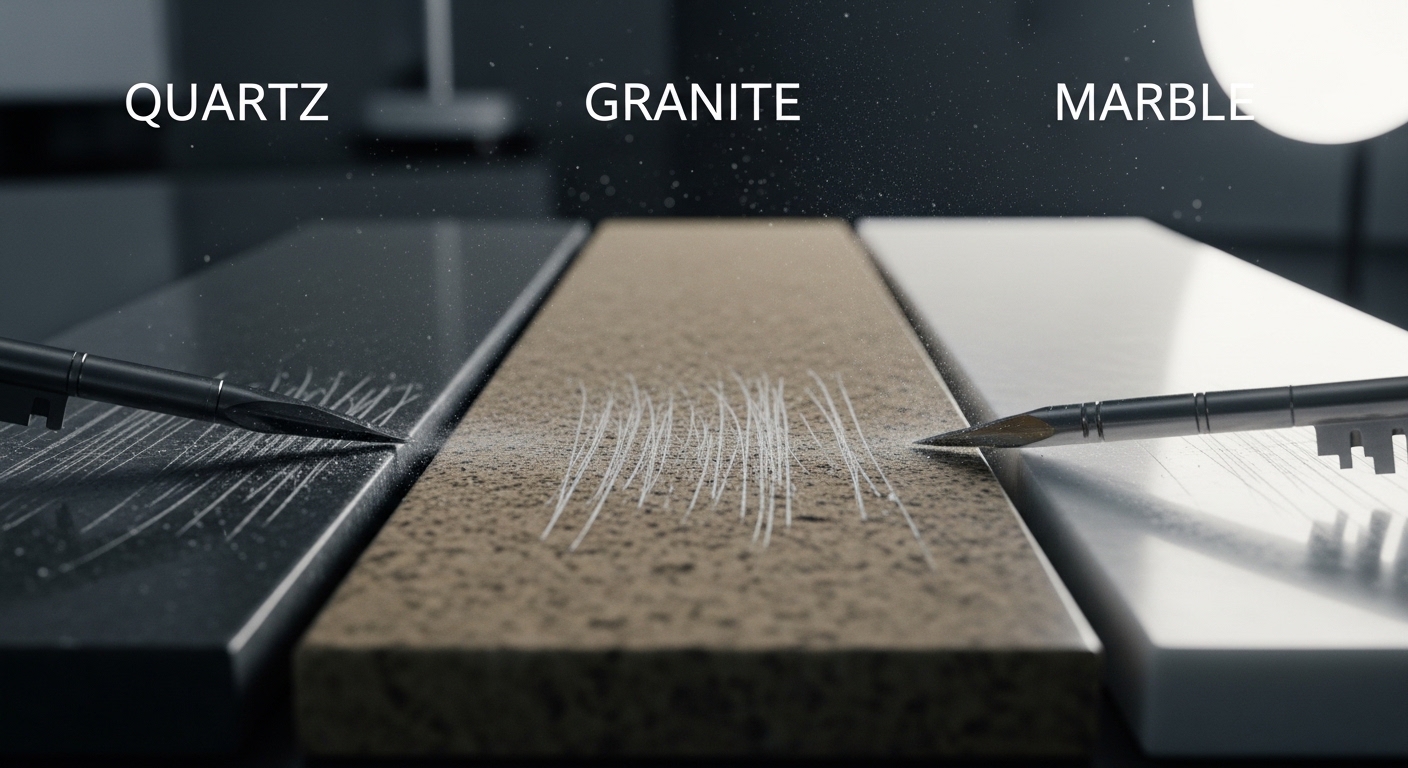
Which countertop can survive your kitchen? We put all three to the ultimate scratch test.
| QUARTZ
7 Mohs Hardness |
GRANITE
6-7 Mohs Hardness |
MARBLE
3-4 Mohs Hardness |
| You’re making a sandwich. You drag a knife across the counter by accident. Your keys slide off the table. A ceramic pot scrapes the surface. Sound familiar? Before you pick your next countertop, let’s find out which stone can handle real life — and which one will show every little scratch. |
What Is a Scratch, Anyway?
A scratch happens when something harder pushes against a surface and cuts into it. Scientists measure how easy it is to scratch something using the Mohs Hardness Scale — a number system from 1 to 10. A 1 is super soft (like talc powder). A 10 is a diamond, the hardest thing on Earth.
Here’s the cool rule: a material can only scratch something with a lower number. So a knife (around Mohs 5.5) can scratch marble, but it will struggle against quartz or granite. Knowing these numbers helps you understand exactly how tough your countertop really is.
Quartz: The Engineered Champion
| Quartz at a Glance
Mohs Hardness: Around 7 — very high Type: Man-made (engineered from crushed stone + resin) Best For: Busy kitchens, families, heavy daily use |
Quartz countertops are not 100% natural stone. Factories take crushed quartz crystals (one of the hardest minerals on Earth) and mix them with resins and pigments to create a super-tough slab. Because it’s engineered, manufacturers can control exactly how hard and consistent the surface is.
With a Mohs score around 7, quartz can handle almost everything your kitchen throws at it. Keys? No problem. Ceramic mugs? Fine. Even metal utensils dragged carelessly across the surface usually leave no permanent mark. Quartz is also non-porous, meaning liquid doesn’t soak in. That’s why it doesn’t stain easily either.
The one thing that CAN scratch quartz? Diamonds and tools made from materials harder than 7 — like certain carbide blades. For everyday life, though, quartz is nearly untouchable when it comes to scratches.
| Fun Fact: The Diamond Test
A diamond (Mohs 10) can scratch quartz. That’s actually how jewelers used to test if a gem was real — real diamonds scratch glass, fake ones don’t. |
Granite: The Natural Tough Guy
| Granite at a Glance
Mohs Hardness: 6 to 7 — high Type: 100% natural igneous rock Best For: Kitchens that want beauty AND toughness |
Granite is a completely natural rock formed deep inside the Earth over millions of years. Volcanoes and intense heat and pressure created it. Because of this wild formation process, granite is packed with several different minerals — mostly quartz, feldspar, and mica — each with their own hardness levels.
On the Mohs scale, granite lands between 6 and 7. That makes it extremely resistant to everyday scratches. Knives, forks, keys, ceramic plates — none of these will typically leave a mark. Granite is even used as a cutting surface in some workshops because it can take punishment that would destroy softer materials.
There’s one small catch: granite is porous. That means tiny holes on the surface can absorb liquids. A countertop that isn’t sealed properly can stain from juice or oil — though it won’t scratch easily. Sealing granite once a year keeps it both stain-free AND scratch-resistant for the long haul.
Marble: Beautiful but Sensitive
| Marble at a Glance
Mohs Hardness: 3 to 4 — low Type: Natural metamorphic rock Best For: Bathrooms, low-traffic areas, elegant spaces |
Marble is one of the most beautiful stones in the world. Artists and architects have used it for thousands of years — think Michelangelo’s David statue or the floors of ancient Roman temples. Its soft, creamy look with flowing veins is genuinely stunning. But here’s the honest truth: marble is not built for tough kitchen life.
With a Mohs hardness of only 3 to 4, marble is surprisingly soft for a stone. A regular steel knife (Mohs ~5.5) can scratch it. Even a copper coin (Mohs ~3.5) can leave a mark. Acidic foods like lemon juice, vinegar, and tomato sauce don’t just stain marble — they etch it, which means the acid actually eats into the surface and creates dull marks that look like scratches.
That doesn’t make marble a bad choice. It just means it needs more care and gentler use. Many designers choose marble for bathroom vanities, fireplace surrounds, or pastry-rolling areas where heavy scratching is less likely.
The Head-to-Head Results
Here’s a clear breakdown of how each stone performs when tested against common kitchen hazards:
| What’s Scratching It? | Quartz | Granite | Marble |
| Steel knife or fork | ✅ Safe | ✅ Safe | ⚠️ May scratch |
| Metal keys | ✅ Safe | ✅ Safe | ❌ Will scratch |
| Ceramic dish or mug | ✅ Safe | ✅ Safe | ⚠️ Possible mark |
| Sand or grit underfoot | ✅ Safe | ✅ Mostly safe | ❌ Micro-scratches |
| Lemon juice / acid | ✅ Safe | ⚠️ Depends on seal | ❌ Etches surface |
| Diamond ring dragged | ❌ Can scratch | ❌ Can scratch | ❌ Will scratch |
So Which One Should You Pick?
The right stone really depends on your lifestyle. If you have a busy kitchen, kids running around, and you’re not the type to baby your countertops, quartz is your best friend. It’s engineered to be nearly scratch-proof in real-world conditions, and it doesn’t need sealing.
If you love the look of natural stone and want something incredibly tough that also tells a unique story in its pattern, granite is a fantastic choice. Just seal it regularly, and it’ll be almost as tough as quartz. Many homeowners say granite gets better looking over years of use.
If you’re decorating a bathroom or a low-traffic area, or you simply adore marble’s classic elegance — go for it. Just treat marble gently, wipe up spills fast, and use cutting boards in the kitchen. With a little love, marble stays gorgeous for generations.
| The Final Verdict
For scratch resistance: Quartz wins, Granite is a very close second, and Marble needs extra care. But for pure beauty and that ‘wow’ moment when guests walk in? All three are winners in their own right. Choose the stone that fits your real life — not just the prettiest photo online. |
Quick Tips to Protect Any Stone
No matter which countertop you choose, these simple habits will make it last much longer:
- Always use a cutting board. Even quartz appreciates it — knives dull faster on stone than on wood anyway.
- Clean up spills right away, especially acids like citrus and wine.
- Use trivets or hot pads under hot pots — thermal shock can crack stone over time.
- Reseal granite or marble once a year to keep it protected from stains and moisture.
A little care goes a long way. Treat your countertop right, and it will look amazing for decades to come.