
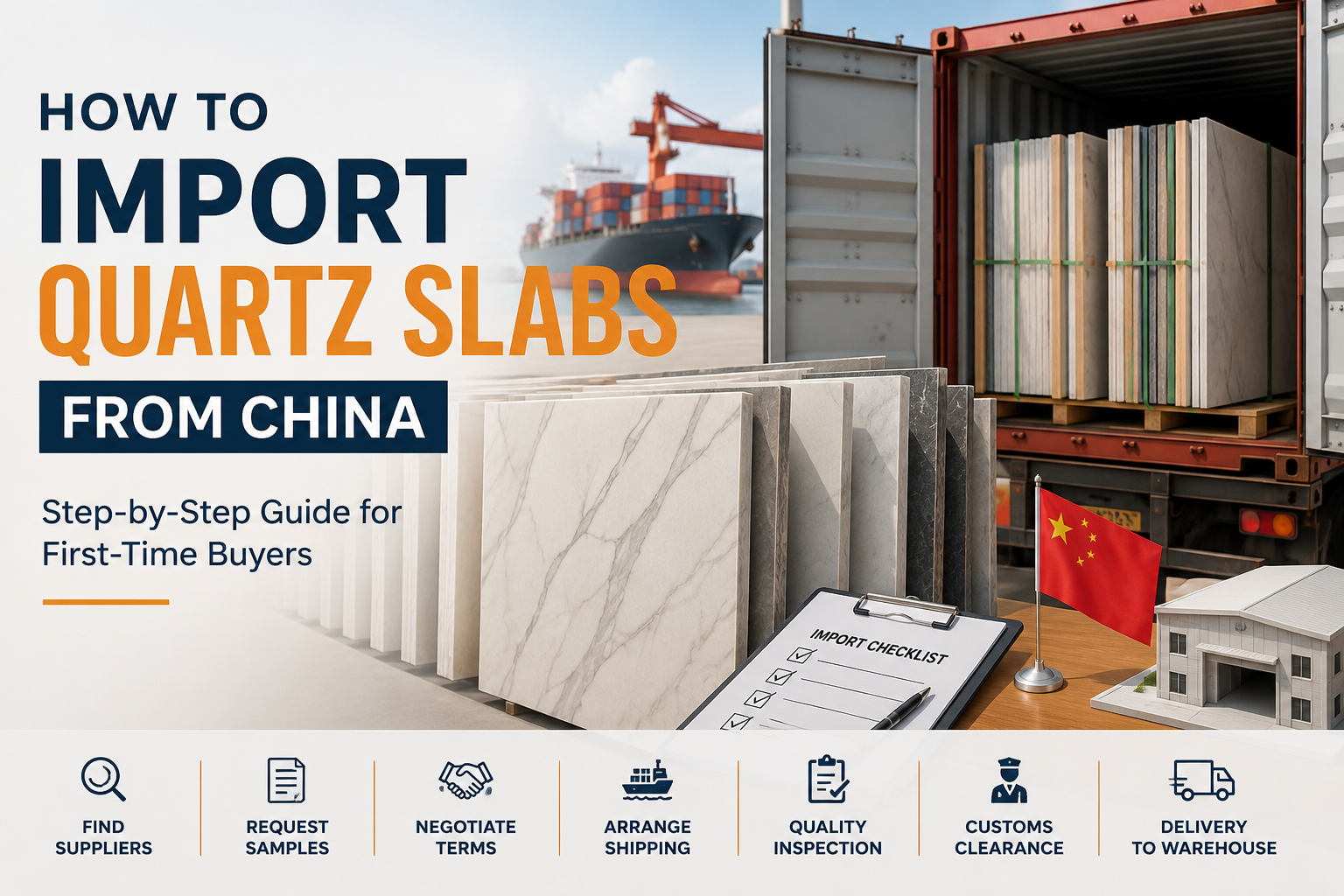
Importing quartz slabs from China can be a profitable opportunity for countertop businesses, contractors, distributors, and building-material suppliers. China has a large manufacturing base, many design options, and competitive prices. However, first-time buyers need to understand the process before placing a large order.
From choosing the right supplier to checking quality, arranging shipping, and clearing customs, every step matters. A low product price does not always mean a low total cost. Freight, duties, packaging, inspections, and other charges can significantly affect your final price.
This guide explains how to import quartz slabs from China in simple, practical steps.
1. Understand What You Need
Before contacting Chinese suppliers, define your requirements clearly.
Start by deciding:
- Quartz slab size
- Thickness
- Color and pattern
- Surface finish
- Edge requirements
- Quantity
- Application, such as kitchen countertops or bathroom vanities
- Packaging requirements
- Target price
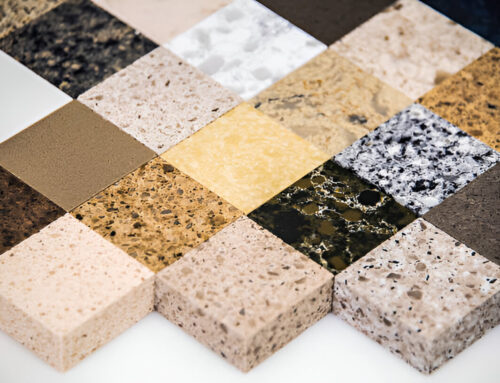
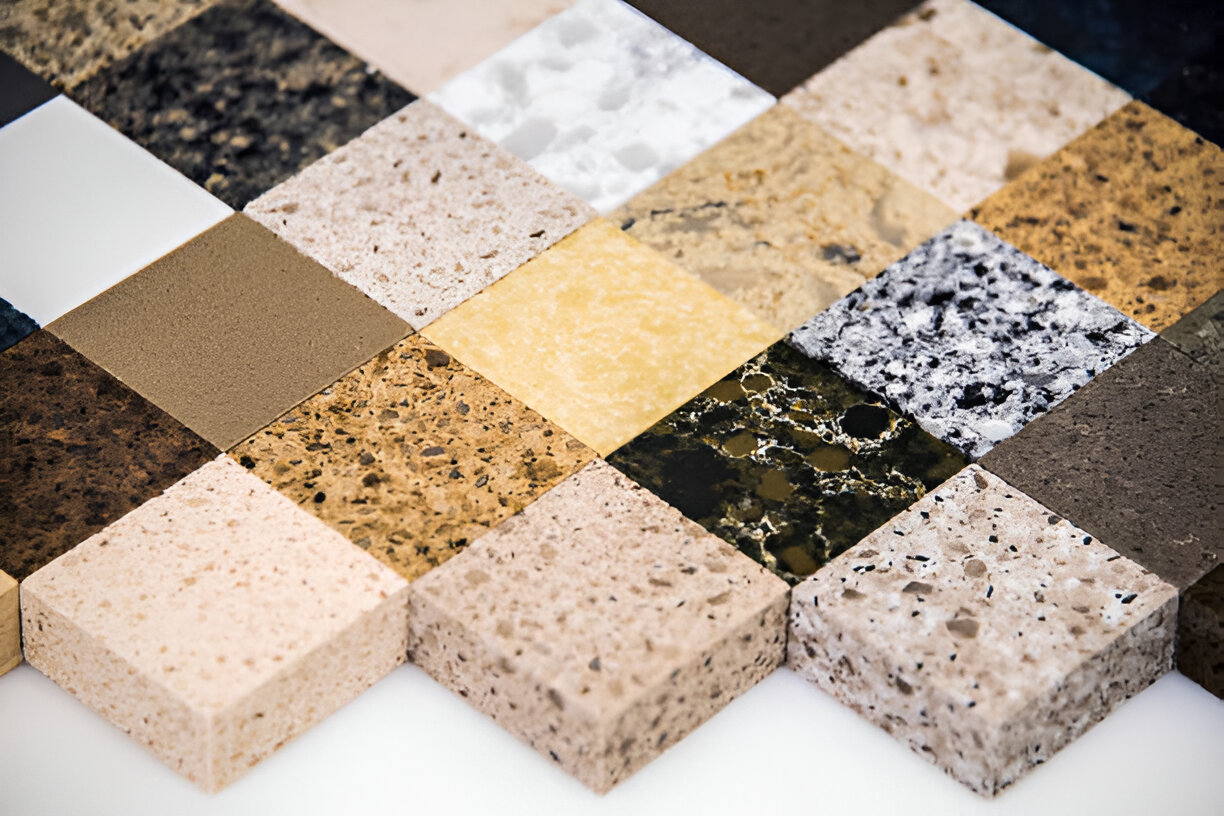
Quartz slabs come in many colors and patterns, including marble-look designs, solid colors, concrete styles, and natural-stone-inspired finishes.
Having a clear specification helps suppliers give you accurate quotations. It also makes it easier to compare different manufacturers.
2. Research the Chinese Quartz Market
China has many quartz slab manufacturers, but not every factory offers the same quality or service.
Research suppliers based on:
- Manufacturing experience
- Product range
- Export experience
- Certifications
- Production capacity
- Quality control process
- Packaging standards
- Customer reviews and references
Do not choose a supplier simply because it offers the lowest price. A very cheap slab may have differences in thickness, color consistency, resin quality, polishing, or durability.
Look for manufacturers that regularly export to your target market. Export experience can make communication, documentation, packaging, and shipping much easier.
3. Shortlist Several Suppliers
It is better to contact several suppliers instead of depending on one company.
Ask each supplier for information about the same product specification. Request:
- Product catalog
- Slab specifications
- Available colors
- Minimum order quantity
- Price per slab or square meter
- Sample availability
- Production time
- Packaging details
- Payment terms
- Shipping options
- Certifications and test reports
Comparing suppliers on the same requirements gives you a more realistic understanding of market prices.
4. Request Samples Before a Bulk Order
Never rely only on product photos when buying quartz slabs.
Ask for physical samples before placing a large order. A sample allows you to evaluate:
- Color
- Pattern
- Surface finish
- Thickness
- Texture
- Edge quality
- Polishing
- Overall appearance
This is especially important for marble-look quartz because photographs may not accurately represent the actual pattern.
If possible, keep the approved sample as a reference for the final production. You can then compare the finished goods against the agreed standard.
5. Verify the Supplier
Supplier verification is one of the most important steps for first-time importers.
Ask whether the company is an actual manufacturer or a trading company. Both can be legitimate, but their pricing, production control, and communication may differ.
You can request:
- Business registration information
- Factory address
- Company profile
- Product certifications
- Factory photos or videos
- Export references
- Quality-control procedures
For a large order, consider using an independent inspection company to verify the factory and production quality.
A few hours of research can prevent expensive problems later.
6. Negotiate the Price and Terms
Once you find suitable suppliers, negotiate the complete deal rather than focusing only on the unit price.
Your quotation should clearly show what is included.
Important terms include:
- Product price
- Quantity
- Packaging
- Loading charges
- Inland transportation
- Port charges
- Shipping terms
- Insurance
- Payment terms
- Production lead time
You may see terms such as EXW, FOB, CIF, or other Incoterms. Make sure you understand what costs and responsibilities belong to you and what the supplier handles.
For first-time importers, working with an experienced freight forwarder can help you understand the actual landed cost.
7. Calculate the Total Landed Cost
The supplier’s price is only one part of your import cost.
Your landed cost may include:
Product cost + packaging + inland transport + export charges + ocean freight + insurance + customs duties/taxes + port charges + customs clearance + local delivery
For example, a supplier may offer an attractive price per slab, but high freight or import costs can reduce your profit.
Before ordering, calculate the estimated cost of getting the quartz from the Chinese factory to your warehouse.
This gives you a better idea of your actual profit margin and selling price.
8. Choose the Right Shipping Method
Quartz slabs are heavy and fragile, so shipping requires careful planning.
For larger commercial orders, ocean freight is usually the practical option. Your freight forwarder can help determine whether you need a full container or another shipping arrangement.
Pay close attention to:
- Container type
- Number of slabs
- Weight
- Loading method
- Port of departure
- Destination port
- Transit time
- Insurance
- Unloading requirements
Quartz slabs should be packed securely to reduce the risk of cracks, chips, and movement during transportation.
9. Confirm Packaging Standards
Good packaging is essential when importing slabs.
Ask the supplier how the slabs will be protected during handling and transportation. Strong wooden or metal frames, protective materials, and proper internal support can help reduce damage.
Before shipment, confirm:
- Slabs are securely supported
- Corners are protected
- Surfaces are protected
- Slabs cannot move excessively inside the container
- Packaging is suitable for long-distance transportation
Request loading photos or videos before the container leaves the factory. These can provide useful evidence of how your order was packed.
10. Arrange Quality Inspection Before Shipment
A pre-shipment inspection can be extremely valuable, especially for your first order.
An inspector can check whether the shipment matches your purchase agreement.
The inspection may cover:
- Quantity
- Dimensions
- Thickness
- Color
- Surface finish
- Pattern consistency
- Visible defects
- Cracks and chips
- Packaging
- Labels
If the inspection finds a serious problem, you have an opportunity to ask the supplier to correct it before shipment.
It is much easier to solve a quality issue while the goods are still at the factory than after they arrive at your warehouse.
11. Prepare the Import Documents
International shipments require accurate documentation.
Depending on your country and transaction, documents may include:
- Commercial invoice
- Packing list
- Bill of lading
- Certificate of origin
- Product certificates or test reports
- Insurance documents
- Customs documentation
Your customs broker or freight forwarder can help identify the documents required for your shipment.
Make sure the product description, quantity, value, weights, and company information are consistent across the documents.
12. Check Import Regulations and HS Classification
Before ordering, find out how quartz slabs are classified for customs purposes in your country.
The applicable HS code can affect:
- Import duties
- Taxes
- Customs procedures
- Required documentation
- Trade restrictions or additional requirements
Do not guess the HS code based only on a supplier’s quotation. Confirm the correct classification with your customs broker or relevant customs authority.
This is an important step because an incorrect classification can cause delays, unexpected costs, or compliance problems.
13. Arrange Customs Clearance
When your shipment reaches the destination port, it will need to go through customs clearance.
A customs broker can handle much of this process on your behalf. They may submit documents, calculate duties and taxes, communicate with customs authorities, and arrange cargo release.
Provide your broker with accurate documents before the shipment arrives. Missing or inconsistent paperwork can delay clearance and increase storage or port charges.
14. Inspect the Shipment When It Arrives
Do not assume everything is perfect just because the supplier passed a factory inspection.
Inspect the slabs as soon as they arrive.
Check for:
- Broken slabs
- Cracks
- Chipped corners
- Scratches
- Incorrect colors
- Wrong quantities
- Packaging damage
- Surface defects
Take photographs and videos during unloading. If you discover damage, keep the packaging and document the problem carefully.
These records can be useful when discussing a claim with the supplier, shipping company, or insurance provider.
15. Build a Long-Term Supplier Relationship
Your first shipment should be treated as the beginning of a supplier relationship, not just a one-time purchase.
If the supplier consistently provides good quality, reliable delivery, accurate documentation, and reasonable communication, future orders can become easier.
Over time, you may be able to negotiate better pricing, customized designs, improved packaging, or more favorable payment terms.
However, continue monitoring quality. A supplier that performs well on one shipment should still be evaluated regularly.
Common Mistakes First-Time Quartz Importers Should Avoid
Several mistakes can turn a profitable import into an expensive problem.
Choosing the cheapest supplier: Low prices can sometimes come with lower quality or weaker service.
Skipping samples: Product photos do not always show the true color, finish, or pattern.
Ignoring landed costs: Freight, customs, taxes, and local transportation can significantly increase the final price.
Ordering too much too soon: Test the supplier with a smaller order before committing to large volumes when practical.
Skipping inspection: A pre-shipment inspection can identify problems before the goods leave China.
Poor packaging requirements: Quartz slabs can be damaged during transportation if they are not properly supported.
Unclear contracts: Make sure product specifications, quantities, prices, delivery terms, and quality requirements are written clearly.
Final Thoughts
Importing quartz slabs from China can give first-time buyers access to a wide range of designs at competitive manufacturing prices. But successful importing requires more than finding a cheap supplier.
Start by defining your product requirements, researching manufacturers, requesting samples, verifying suppliers, and calculating your complete landed cost. Then focus on quality inspection, strong packaging, correct documentation, shipping, and customs clearance.
The safest approach is to start carefully, learn from your first shipment, and build a reliable supply process. With proper planning and supplier management, importing quartz slabs from China can become a valuable part of your countertop, construction, or stone distribution business.



Leave A Comment